

Hey there! I'm a supplier of 304L Stainless Steel Pipe, and today I wanna chat about the heat - transfer coefficient of 304L stainless steel pipe.
First off, let's understand what the heat - transfer coefficient is. In simple terms, it's a measure of how well a material can transfer heat. It tells us how fast heat can move through the wall of the pipe when there's a temperature difference between the inside and the outside of the pipe. For 304L stainless steel pipes, this coefficient is super important, especially in industries where heat transfer is a key part of the process, like in chemical plants, food processing, and HVAC systems.
The heat - transfer coefficient of 304L stainless steel pipe isn't a fixed number. It depends on a bunch of factors. One of the main factors is the temperature. As the temperature changes, the thermal conductivity of 304L stainless steel also changes, which in turn affects the heat - transfer coefficient. Generally, as the temperature goes up, the thermal conductivity of 304L stainless steel increases, but not in a linear way.
Another factor is the flow conditions inside and outside the pipe. If the fluid inside the pipe is flowing rapidly, it can enhance the heat transfer. Turbulent flow usually leads to a higher heat - transfer coefficient compared to laminar flow. On the outside of the pipe, the type of fluid (gas or liquid), its flow rate, and its properties also play a role. For example, if the pipe is surrounded by a liquid with high thermal conductivity, the heat - transfer coefficient will be different compared to when it's surrounded by a gas.
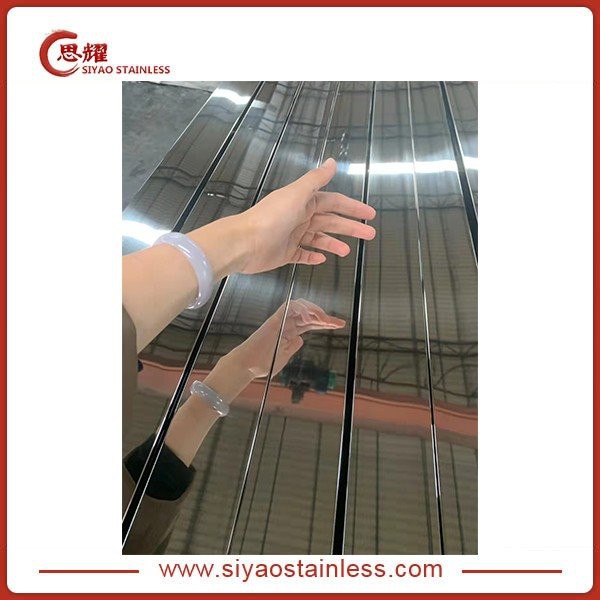

The surface condition of the pipe also matters. A smooth - surfaced 304L stainless steel pipe will have a different heat - transfer coefficient compared to a pipe with a rough surface. Rough surfaces can create more turbulence in the fluid flow near the pipe wall, which can increase the heat - transfer rate.
Now, let's talk about some typical values. The heat - transfer coefficient of 304L stainless steel pipe in natural convection (when the fluid moves due to density differences caused by temperature variations) is relatively low. It can range from about 5 - 25 W/(m²·K). In forced convection (when the fluid is forced to move, like by a pump or a fan), the heat - transfer coefficient can be much higher, typically in the range of 25 - 1000 W/(m²·K) or even more, depending on the specific flow conditions and fluid properties.
In heat exchanger applications, where 304L stainless steel pipes are commonly used, the heat - transfer coefficient is a crucial parameter. Engineers need to calculate it accurately to design an efficient heat exchanger. They use complex equations and correlations that take into account all the factors I mentioned earlier.
If you're in the market for 304L stainless steel pipes, you should know that the heat - transfer performance is just one aspect to consider. But it's an important one, especially if your application involves heat transfer. At our company, we offer high - quality 304L Stainless Steel Pipe that can meet various heat - transfer requirements.
We also have other types of stainless steel products, like Stainless Steel Square Tube and Stainless Steel Box Section. These products can also be used in different heat - transfer applications, and they have their own unique heat - transfer characteristics.
If you're interested in learning more about the heat - transfer coefficient of 304L stainless steel pipes or want to discuss your specific requirements, don't hesitate to reach out. Whether you're an engineer designing a new heat exchanger, a plant operator looking to upgrade your equipment, or a contractor working on a project, we can provide you with the right products and technical support.
We understand that every project is different, and we're here to help you find the best solution for your heat - transfer needs. Our team of experts can assist you in choosing the right pipe size, wall thickness, and surface finish to optimize the heat - transfer performance.
So, if you're ready to take your heat - transfer project to the next level, contact us today. We're eager to work with you and make your project a success.
References:
- Incropera, F. P., & DeWitt, D. P. (2002). Fundamentals of Heat and Mass Transfer. Wiley.
- Holman, J. P. (2002). Heat Transfer. McGraw - Hill.